
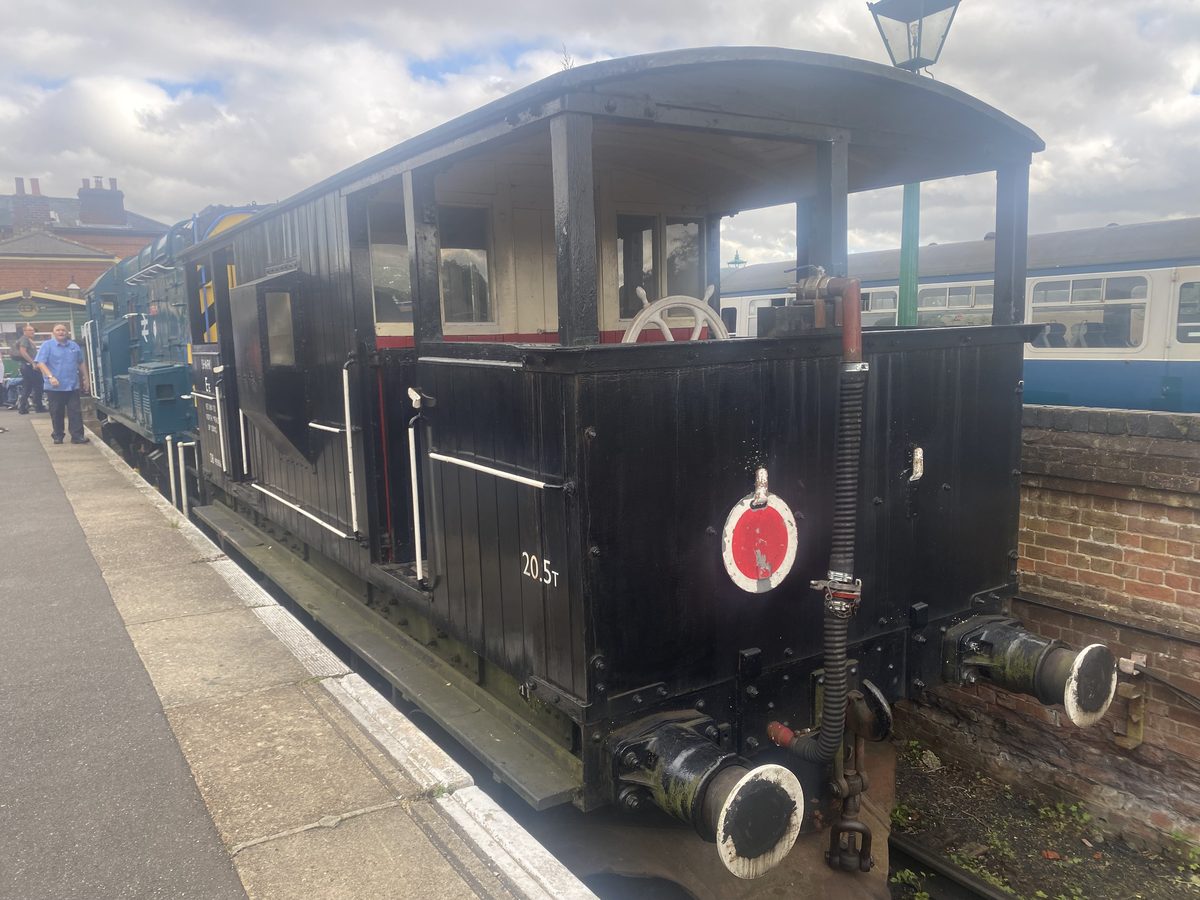
The “Shark” is one of the most recognisable vehicles in British railway engineering history. Officially a ballast plough brake van, the Shark was a heavy, veranda-ended brake van fitted with a steel plough at each end, used to spread and level freshly dropped track ballast. Its telegraphic code name “Shark” was shared by several quite different ballast plough designs, but the type most commonly associated with the name is the British Railways standard design of the 1950s, based on an LMS predecessor and, behind that, a Caledonian Railway original. This post traces the history of the Shark from its pre-war origins through to its survival on heritage railways today.

A Shark Brake Van at the Epping Ongar Railway
What Is a Shark?
A brake van is the wagon that sat at the rear of a goods train, carrying the guard and providing supplementary braking. A ballast plough brake van took that basic vehicle and added a profiled steel plough beneath each veranda. When a permanent-way train dropped ballast from the underside doors of hopper wagons, the Shark was towed or propelled through the freshly laid stone, the plough redistributing it evenly across the track bed and between the sleepers.
The plough is a shaped steel blade with raised sections clearing the rails and rail fastenings, and lower sections in the four-foot and sleeper-end areas where the ballast is wanted. Its height is adjustable by a hand wheel on the veranda, so the operator can raise it clear of obstructions such as pointwork or AWS magnets when needed. Each end carries an identical plough assembly, so the van can work in either direction. Two securing screws and locking bars retain the plough in the raised, travelling position.
The Telegraphic Code Name
British Railways gave its engineering wagons telegraphic code names so that they could be ordered and tracked by telegraph. Ballast plough brake vans of all designs were given the code “Shark”. The name therefore covers more than one family of vehicle: the South Eastern & Chatham Railway design of 1914 (which passed to the Southern Railway and then British Railways), and the LMS-derived British Railways standard design of the 1950s. The telegraphic name stuck, and “Shark” remains the common term for both.
Design Lineage: Caledonian, LMS and British Railways
The LMS-derived Shark descends from a Caledonian Railway design. The Caledonian built six ballast brake vans of this type between 1902 and 1906, and the LMS in turn based its own design on that precedent. When British Railways was formed in 1948, it adopted the LMS brake van as the basis for a new standard ballast plough brake van, taking advantage of the fact that a brake van was already required at the rear of permanent-way trains.
Two diagrams were produced:
- Diagram 1/597 — the principal design. 206 vehicles were built to this diagram between 1951 and the early 1960s, by British Railways workshops and private builders such as Birmingham Railway Carriage & Wagon. A typical example is DB993860, built in 1957 by Birmingham Railway and Carriage Works (lot 2040).
- Diagram 1/598 — a variant, of which an unknown number were built; only one example is known to survive today.
The other family — the SE&CR design — originated with prototype number 6330, built in 1914 to diagram 3489. The Southern Railway adopted the design shortly before nationalisation and built a few examples in 1949. Four of these older Sharks survive today, including examples on the Bluebell Railway and the Kent & East Sussex Railway.
Construction and Dimensions
The BR standard Shark is a 20-ton vehicle. It has a wooden body on a steel underframe, with the characteristic enclosed cabin and veranda platforms at each end carrying the plough mechanism and the height-control wheel. The design is derived from the LMS 20-ton brake van, with the plough assembly and its supporting framework added. The body is fitted with duckets (side look-outs) to give the guard a view along the train, a stove for heating, and the usual brake van interior: hand brake wheel, vacuum brake handle and gauge, sand boxes and the guard’s padded seat and desk.
Operation and TOPS Codes
Sharks were departmental (engineering) stock, and under TOPS they were reclassified with codes beginning “Z”, the “T” indicating a brake van and the “U” indicating a plough. The full set of plough brake van codes is:
| TOPS code | Name | Brake type |
|---|---|---|
| ZUA | Brake van plough | Air brake only |
| ZUB | Brake van plough van | Air brake and vacuum pipe |
| ZUP | Brake van plough | Vacuum pipe |
| ZUQ | Brake van plough | Air pipe |
| ZUV | Brake van plough | Vacuum brake only |
| ZUW | Brake van plough | Vacuum and air pipe |
In service a Shark would typically be found at each end of a train of ballast hoppers, so that ploughing could take place in either direction without running round. They were unpowered and either towed or propelled. In a 2006 Rail Accident Investigation Branch report, 26 Sharks were recorded as still in use on the national network, with further examples on heritage railways.
Liveries
Sharks have worn an enormous variety of liveries over their lives, which makes them a popular subject for modellers. Early examples appeared in British Railways’ standard departmental finishes, and over the decades they received the full range of BR and post-privatisation schemes: BR Engineers’ black, Olive Green, the various grey and yellow departmental schemes, and later Loadhaul black and orange, EWS maroon and gold, and many others. The number of different markings is reflected in the decal sheets produced for model kits.
Survival and Preservation
Despite being replaced by more modern ballast-handling machines, Sharks have survived in not-infrequent mainline use and are a common sight on heritage railways, where they are among the principal departmental vehicles, assisting with ballast laying and other permanent-way duties. They also appear on brake van rides at gala events.
Notable preserved examples include:
- DB993860 (built 1957, Birmingham Railway and Carriage Works, lot 2040, diagram 1/597) — Eden Valley Railway, regularly used on the works train.
- DB993856 (built 1959) and DB993760 (built 1954) — Epping Ongar Railway.
- DS62862 (built 1949, to an SE&CR design of 1914) — Kent & East Sussex Railway, used during the extension to Bodiam in the late 1990s.
- DB993733 — left in a siding at Shenfield station from around 2009 to late 2018.
In total, 48 examples of diagram 1/597 are known to survive, plus one diagram 1/598. Of the SE&CR/Southern family, four survive, the youngest on the Bluebell Railway and the eldest at the Mangapps Railway Museum.
Modelling the Shark
The Shark is a popular modelling subject, available in several gauges as kits and ready-to-run models. Its distinctive veranda-ended profile, ploughs and variety of liveries make it a striking addition to a permanent-way train.


Leave a Reply